A year in books - 2025
A list of all of the books I read in 2025, with a few notes attached to each of them.

Please enjoy this list of books I read in 2025, 162 in all.
Unfinished
- "Neo-Nazi Postmodern: Right-Wing Terror Tactics, The Intellectual New Right, And The Destabilization Of Memory In Germany Since 1989" by Esther Elizabeth Adaire managed to evoke genuine anger in me. I've rarely read a book that was so busy intellectualizing an issue, locking itself into its own ivory tower of academic analysis, while completely missing basic realities and bigger pictures at the same time.
Don't get me wrong, I'm all for studying the political motivations, machinations and mechanisms behind extreme right-wing politics. But this .. this book is not that. It felt like a 300-page attempt at proving the moral high ground. - "Know Thy Second Brain: The Art of Collaborating with AI and Yourself" by Zenson Tran is probably what you would get if you asked ChatGPT, DeepSeek or Mistral to pretend to be the worst kind of tech bro and to write a book about AI. I did not expect to have to read the sentence "The elites don't want you to know this!" in a book in 2025. I'm glad I gave up after 30 pages, because .. that was horrible.
- "Die Niederlage des Siegers: Der Hamas-Angriff - Hintergründe und Folgen" by Jacques Baud - "Hamas did nothing wrong"
- "Understanding Hamas And Why That Matters" by Helena Cobban and Rami G. Khouri - - "Hamas did nothing wrong"
- "AI Value Creators - Beyond the Generative AI User Mindset" by Rob Thomas, Paul Zikopoulos, Kate Soule; TL;DR: despite being published by O'Reilly it's still weird and I don't get AI.
- "Hybrid Warfare - The Russian Approach to Strategic Competition and Conventional Military Conflict" by Curtis L. Fox is barely concealed slop put out by some form of generative AI. It has, seemingly, not even been proofread properly.
- "Putins digitale Front und die Wahrheit dahinter" by Steven Broschart - bad paper in book form, half of this is screenshots .. kind of angry at myself that I paid for this.
- "Hubris" by Jonathan Haslam - I generally respect the author as a scholar, but in this he was a bit too confident in himself, to the point that it became uncomfortable. He has some interesting theories, but not enough facts or data points to support them, and at times there were even factual issues with the book.
- "Disinformation: Former Spy Chief Reveals Secret Strategies for Undermining Freedom, Attacking Religion, and Promoting Terrorism" by Ioan Pancepa; tried really hard, started out good, went full conspiracy after the first half.
- "Drone Wars - The Future of Conflict" by Donald Elton; the fact that it was written by "a Pulmonary and Critical Care physician in Central Florida with an interest in the history of the Americas" should have given me pause .. really bad, parts certainly written by ChatGPT (or another LLM).
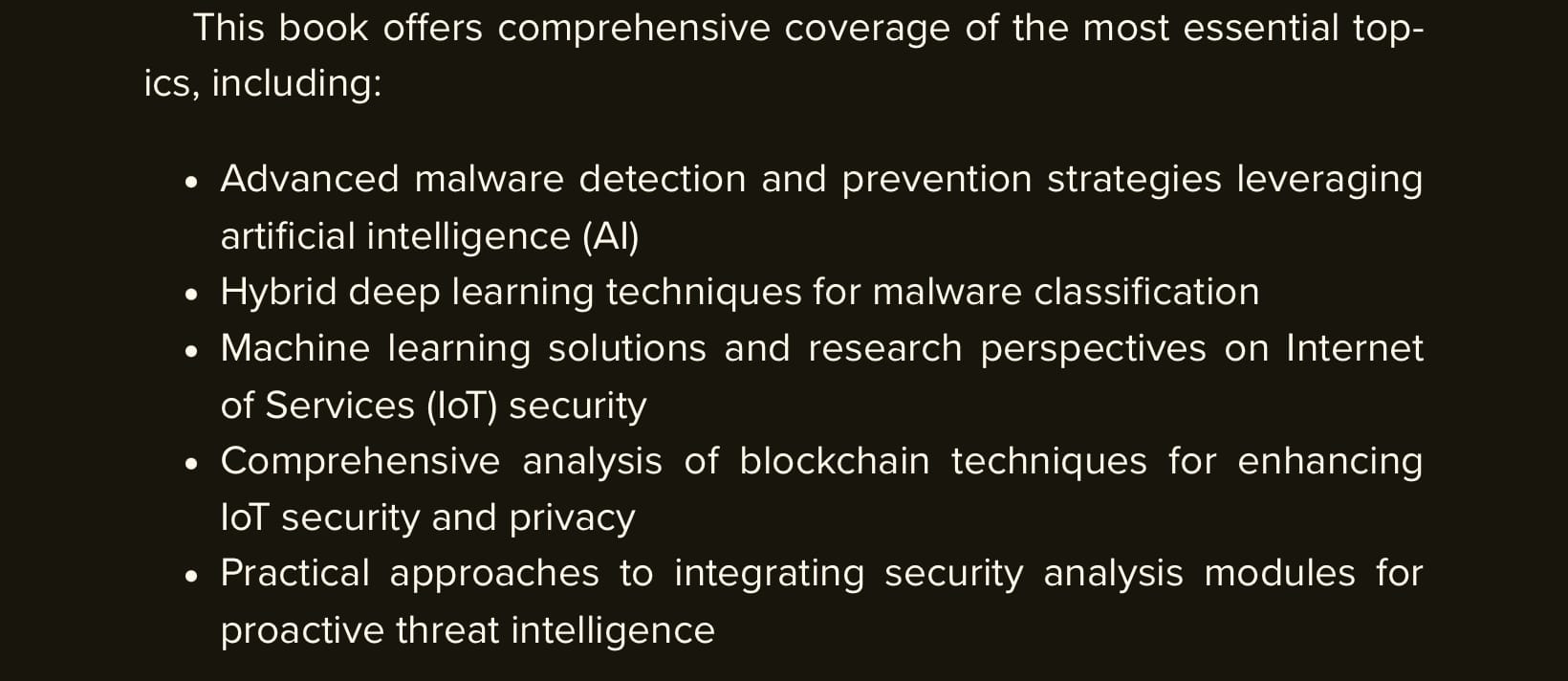
- "The Art of Cyber Defense: From Risk Assessment to Threat Intelligence" by Youssef Baddi, Mohammed Amin Almaiah, Omar Almomani, Yassine Maleh; buying this book would set you back 140 bucks. This would get you a compilation of written words with an introduction that contains the following, which is all I am going to say as explanation as to why I quit this book halfway through:
December
- "Für Russland ist Europa der Feind" by Andrey Gurkov is a rather unsparing analysis of Russia's growing hostility toward Europe, particularly in the wake of the full-scale invasion of Ukraine.
The author argues that Russia has decisively turned away from European values and embraced an almost purely imperialist worldview. By looking at historical, cultural, and psychological factors, Gurkov explains how this shift has taken root in Russian society and warns against Western illusions of a return to pre-war relations .. which, for some reason, especially Germany seems to still harbor. - "The Umbrella Murder: Observer Book of the Week and Shortlisted for Fingerprint Crime Awards" by Ulrik Skotte was an engaging read, but I was not quite sure what to make of this book .. it seems like the author wasn't sure either, and this is his attempt of sorting his own research and thoughts. I guess it's still worth a read, given that it's the first modern work dedicated to the "mystery" of this specific murder, but still .. an odd one.
- "The Odessa File" by Fredrik Forsythe; a while ago I stumbled upon the movie on Youtube, was intrigued, ended up watching the film and reading the book. Good thriller / crime drama.
- "Russia's Gamble - The Domestic Origins of Russia's Attack on Ukraine" by Vladimir Gel'man is an excellent policy analysis and - as well as because of its denity - definitely not a book I would recommend to read for beginners.
- "Russians Among Us: Sleeper Cells, Ghost Stories, and the Hunt for Putin's Spies" by Gordon Corera; not bad, but could have been much shorter, a bit repetitive at times, nonetheless interesting insight into the day-to-day challenges of both the illegals and the law enforcement / intelligence agencies trying to track "stop" them
- "How Isis Fights: Military Tactics in Iraq, Syria, Libya and Egypt" by Omar Ashour is the first "rational" analysis I've read about the military prowess (or lack thereof) of various parts of the Islamic State at various points of its existence. The bottom line, which I consider a vital point of note, is that it sufficed for their purposes that they were merely mediocre, because all their adversaries were often times far below that.
- "Terrorist Criminal Enterprises: Financing Terrorism through Organized Crime" (edited by) Kimberley L. Thachuk was short, concise, unexpectedly readable and rather worrying - because I know way too much the authors talked about already.
- "Putins Welt: Das neue Russland, die Ukraine und der Westen" by Katja Gloger; you know the feeling when a book feels .. "unnecessary", for lack of a better word? This book felt like an assortment of newspaper articles and essays. Not bad, but like .. not worth it
- "The Architect of Espionage" by Samuel M. Katz; didn't know what to expect, got more of a personal portrait than a professional look at a career; still good book.
- "Ursuns Teeth" by Graham McNeill; didn't realize that there were only two books of the Ambassador series. Felt a bit rushed, still entertaining
- "Modern Hybrid Warfare" by Ryan C. Maness; this book was a wild ride in the worst way possible .. interesting, sound analysis followed by getting basic facts wrong or engaging in thought experiments about war in space that sounded like a mushroom trip gone wrong - if you already know stuff you can read it, as someone new to the field this is going to fill you with lots of bullshit.
- "Germany's Russia Problem - The struggle for balance in Europe" by John Lough; if you're not German, read this, it helps understand why Germany is sometimes so seemingly weird about Russia.
- "Russian Nuclear Orthodoxy: Religion, Politics, and Strategy" by Dmitry Adamsky; Nuclear is only the introduction, good general explanation of how Orthodoxy reconquered Russia and how it shapes large spheres of Russian society to this very day.
- "Aflame: Learning from Silence" by Pico Iyer is one of those books that's hard to describe, .. a personal story about the power of silence? Definitely a feel-good read.
- "The Gift of Fear: And Other Survival Signals That Protect Us from Violence" by Gavin de Becker; mixture of weird-ish pop science and actual good stuff about how violence and escalatory behaviour works in humans.
- "Do Nothing: How To Break Away From Overworking, Overdoing and Underliving" by Celeste Headlee; best sneaky critique of capitalism out there, insightful, makes you think
- "Laziness Does Not Exist" by Devon Price; similar vein to "Do Nothing", started out strong, got a bit too politic-y for my taste in the latter half of the book
November
- "The Punishment of Gaza" by Gideon Levy, author feels very strongly, interesting and somewhat challenging to see a different side, criticism from inside the "establishment" and such, sometimes a bit too ignoring-the-reality.
- "The Killing of Gaza: Reports on a Catastrophe" by Gideon Levy; see above
- "Pirate Enlightenment, or the Real Libertalia" by David Rolf Graber; I mean interesting read and all, fun history lessons .. but I didn't really get the point and all that
- "Israel's Forever War" by Paul Moorcraft; was okay, it was a tad bit too superficial at times; the author takes an interesting stance on / has an interesting approach regarding the two state solution.
- "Eighteen Days in October: The Yom Kippur War and How It Created the Modern Middle East" by Uri Kaufmann; this book takes a detailed look at the history of the 1973 Yom Kippur War. It's a balanced narrative that explores both the military engagements and the war's profound, lasting impact on the Middle East. Or, to put it like my original notes on the book: "Jesus, what a clusterfuck".
- "Europas Brandstifter: Putins Krieg gegen den Westen" by Markus Bensmann, David Schraven; more an assortment of articles by CORRECTIV, still a depressing read, shows how deep Germany is up Russia's ass.
- "ACAB - All Cops Are Bastards" by Carlo Bonini; I was looking forward to this ever since I saw the movie based on it nearly two decades ago; it's an intense read, unfortunately the English translation is of seriously questionable quality at times.
- "Siedlerkolonialismus: Ideologie, Gewalt und Gerechtigkeit" by Adam Kirsch; bro, what the fuck are those people smoking? Settler colonialism is such a bullshit theory .. and that's about all I can say about this book. I think that technically, the book is good. But it deals with such a weird theory that it's hard to say that.
- "Die Liebe zum Hass - Israel, 7. Oktober 2023" by Abdel-Hakim Ourghi; "Israel Alone" written by a Muslim author
- "Murder in Cairo - Solving a Cold War Spy Mystery" by Peter Gillman and Emanuele Midolo; written like a spy thriller, truly engaging, very interesting read - unfortunately not fully solved.
- "The Ambassador" by Graham McNeill; finally a good 2000-era Warhammer book again!
- "Chasing Shadows" by Ronald J. Deibert; good introduction into the topic of commercial spyware, recommended for non-technical people.
- "China's Spies - Beijing's Espionage Offensive" by Nigel West; what a waste of time - a few chapters of generic high-level information about Chinese espionage, followed by 50 pages of random examples of Chinese economic espionage indictments .. absolutely not worth it.
- "Murder in the Gulag: The explosive account of how Putin poisoned Alexei Navalny" by John Sweeney; in short: how the hell did Navalny survive for that long? The book was interesting, balanced, and - something rarely done - acknowledges the fact that Navalny wasn't a saint or perfect, and that there were personal and political issues to / with him.
- "Der nasse Fisch", "Der stumme Tod" by Volker Kutscher; yeah so Babylon Berlin was much better than this, won't continue.
- "Russian Military Thought: The Evolution of Strategy Since the Crimean War" by Gudrun Persson; challenging topic to turn into an engaging read, but surprisingly "approachable" tons of new information, excellent analysis as far as I can judge
October
- "The World of the Cold War 1945 - 1991" by Vladislav Zubok is similar to a lot of books about the Cold War in that it talks a lot about certain key incidents or developments - the Korean War, the Berlin crisis, Korean Air Lines Flight 007, and so on. The difference to other books is that it doesn't focus on the minute-by-minute, but instead puts those in a wider historical and political context. I would definitely recommend it to anyone who wants to deepen their understanding of this historical period.
- "Kompromat - How Russia Undermined American Democracy" by Jeff Pegues; a lot of the books I read about or that dealt with the Russian interference in the United States elections of 2016 were written by researchers, historians, intelligence professionals, or other people who were "in the know", as in "talking about it was their bread and butter".
Jeff Pegues on the other hand is a journalist, and while he has had significant experience with US politics and the national security apparatus, experiencing the development and effect of Russian activities first-hand and how it changed the United States was something new for me. And reading his telling of how it shaped his surroundings (and in some way him) makes for a good read. - "Why Women Have Better Sex Under Socialism - And Other Arguments for Economic Independence" by Kristen R. Ghodsee; the baseline of this book is that according to the author, socialist societies are better for women. She argues that social safety nets create a fairer and better society for women, and that under unregulated free markets, the primary burden of parenting, elder-care and care for the sick falls on women who end up providing the labor for free.
The book isn't bad, but it feels like a very long essay on something that can be summarized in a sentence: Unregulated capitalism is a bad idea. - "Zero Point - Essays No.002" by Slavoj Zizek is (as the name implies) a collection of essays by Zizek. If you enjoy his work, you'll like it. If you don't .. well, you won't like this either.
- "Die Söldner des Kremls" by Lou Osborn and Dimitry Zufferey; where (the excellent) "Death Is Our Business: Russian Mercenaries and the New Era of Private Warfare" focuses almost entirely on Wagner itself, its history and development, as well as some details of their operation, this book takes a more high level look at the group and how they interact with the wider political and military system in Russia. These two books complement each other well.
- "Beirut Rules" by Fred Burton
- "The Sword of Freedom" by Yossi Cohen - I heard a lot of criticisms about this book by (mostly) Israelis, saying that it's not so much a book about the history of Mossad, but rather a preparatory text for Cohen himself to enter politics.
I can definitely see why they feel that way. The book is not so much about the Mossad per se, but rather more of a philosophical tracrate about intelligence work, history, Israel, and world politics.
While that would indeed be a disappointment if my "hard expectations" were a history of the Mossad, I can't say that I didn't enjoy the read. It was an interesting window into the thinking of someone from the highest echelons of Israeli intelligence. - "Six Days of War - June 1967 and the Making of the Modern Middle East" by Michael B. Oren - to sum up the content of this book it suffices to say that the Middle East was a clusterfuck even before the war, and it continued to be a clusterfuck afterwards. I know, I know. Total surprise.
The book did a great job highlighting how confusing and chaotic the political situation was at the time, both between Israel and the Arab world as well as within all the different states. The war would have been entirely inevitable if it weren't for a bunch of people who were not willing to to reign in their egos .. I know, I know. Once again, shocking and a complete surprise. - "Israel Alone" by Bernard-Henri Levy - this was a very emotional, deeply personal text about Israel after October 7th. While the author is undeniable positively inclined towards Israel, both the concept of it and the actual state, the book is reasonably neutral and objective. Carefully analyzing developments after the attack and condemning a lot of the Western world, while being careful to acknowledge issues within Israel.
- "After the Pogrom - 7 October, Israel and the Crisis of Civilisation" by Brendan O'Neill; this was a searing and unflinching critique of the West's moral response to the attacks of October 7th, 2o23. The author eloquently manages to describe exactly what my issue is with large parts of the Western "Free Palestine"-camp.
The author argues that the global reaction (marked by silence, justification, and even denial of the atrocities) revealed a profound crisis in Western values, particularly among academics, activists, and media elites. And how it doesn't look like the situation will get better any time soon. - "Cursed Victory - A History of Israel and the Occupied Territories" by Ahron Bregman; this book is a deeply critical account of Israel's occupation of the West Bank, Gaza, Golan Heights, and Sinai from 1967 to the early 2000s. The author, a former Israeli soldier turned academic, manages to highlight the systemic oppression, failed peace efforts, and long-term consequences of the occupation for both Palestinians and Israelis - all while not sounding like someone who has a grudge against the Israeli establishment. Depressing, but still great read.
- "The Ghost Warriors: Inside Israel's Undercover War Against Terrorism" by Samuel M. Katz - I hadn't heard of the Yamas, the undercover anti-terror unit of the Israeli border police before reading this book. So in that regard, I gained a lot of new knowledge and insight.
At the same time there were moments where I was rather close to abandoning the book. It was very enthusiastic about the unit, which was described as pretty much the epitome of everything good, and in general lacking any criticism of Israeli strategy, tactics, and action. I would recommend reading it cautionary and taking everything in it with quite some grains of salt. - "The Weapon Wizards" by Yaakov Katz looks at Israel's rise as a global leader in military innovation. The authors trace the development of technologies such as drones and missile defenses and how Israel's security challenges and culture of innovation have driven its military-industrial success - which is believable and consistent with reality, but the book still feels like a propaganda effort a lot of the time.
September
- "The Hamas Intelligence War Against Israel" by Netanel Flamer; the book takes a look at Hamas's intelligence operations from its founding in 1987 to 2021. By relying mainly on primary sources this book provides a dispassionate, fact-driven analysis of how Hamas developed its intelligence capabilities against Israel.
It was especially enjoyable because it was written in a clear, neutral, objective style (something a lot of books about this conflict lack), while still being engaging. - "A High Price: The Triumphs & Failures of Israeli Counterterrorism" by Daniel Byman is (to my understanding) comprehensive and (at least it seems that way) balanced of Israel's counterterrorism efforts from its founding to the early 2010s. It analyzes both Israel's successes (such as targeted assassinations and defensive innovations) and its failures, including a lack of long-term strategy and the political fallout from aggressive tactics.
- "Russia Under Putin - Fragile State and Revisionist Power" (edited) by Andrew S. Natsios; this collection of essays attempts to analyze the paradox of Vladimir Putin's Russia - a state that is internally fragile (plagued by demographic decline, economic stagnation, and systemic corruption), yet aggressively revisionist on the global stage.
The book explores how Russia, despite its weaknesses, has leveraged military power, cyber warfare, and disinformation to challenge the international order and assesses the long-term risks posed by a regime that combines internal instability with imperial ambition. - "Wanna F*ck" by Bel Olid
- "Shooting Crows" by Trevor Birney investigates the 1994 Loughinisland massacre and the subsequent cover-up by British security forces. The author combines firsthand reporting with archival evidence to expose the collusion between loyalist paramilitaries and the state, as well as the harassment he and his colleague Barry McCaffrey faced for their investigative work. The latter was especially depressing to read about, because it was just so .. blatantly obvious harassment.
- "Stop the Machines: The Rise of Anti-Technology Extremism" by Mauro Lubrano; I was obviously aware that there is more to anti-technology extremism than the Unabomber (I know his government name, I can pronounce his government name, but I sure as hell will not try to spell his government name ..), but I wasn't familiar with the different "approaches" to it taken by different political sides.
The book was relatively short, and thus the author didn't go into to much detail. But it certainly encouraged me to research more on my own. - "Das Spiel ist aus: Fußball und Verbrechen" by Andreas Bock is a collection of true crime stories from the world of football. The author explores infamous cases - from match-fixing and corruption to violent crimes involving players, referees, and fans - and manages to blend (seeming) investigative rigor with engaging storytelling.
- "La Doce: Die wahre Geschichte der barra brava von Boca" by Gustavo Grabia; within the world of support culture in football, Argentinian "barras bravas" are a fascinating outlier - because while many organized fanclubs have / have had connections to organized crime or engage in some form of it themselves, there are very few other examples where fanclubs are so blatantly criminal enterprises.
Because of the language barrier there is next to no Western literature on them, which is why I was particularly excited when I stumbled upon this. Unfortunately it's not a particularly good book. The author goes into too much detail.
While I understand that it's vital to are aware of the key figures in order to grasp the structures of these organisations, spending twenty pages to meticulously explain every single action taken during an internal feud (while constantly threwing new, sometimes very similar nicknames for different persons at you) makes for a hard read. You must be really interested in the subject matter to be able to get some enjoyment out of it. - "Ein Glück, dass ich den Tod nicht fürchte - Leutnant Julija Mykytenkos Kampf für die Ukraine" by Lara Marlowe; this book is an account of Julija Mykytenko, a 29-year-old Ukrainian drone unit commander, offering a raw, firsthand perspective on the daily realities of war. If you're only following the war from an analytic perspect, books like this are an important reminder that there's a human cost to it.
- "Data Engineering for Cybersecurity" by James Bonifield; a great hands-on guide using tools like Filebeat, Logstash, Redis, Kafka, and Elasticsearch for security purposes - give this one to juniors, it's great if you are new to this (or coming back to infosec after a long-ish break)
- "Putin's Sledgehammer" by Candace Rondeaux is a well-researched, in-depth exposé of the Wagner Group. The author, drawing on leaked documents and interviews, highlights not just the role Wagner plays in Russian policy, it also highlights the corruption, infighting, and fragility within Russia's military and security apparatus. Combine this with "Death Is Our Business: Russian Mercenaries and the New Era of Private Warfare" and you get a good grasp of the topic.
- "Red Leviathan" by Ryan Tucker Jones; until I read this book I wasn't aware of the Soviet Union's clandestine, industrial-scale whaling campaign, which nearly drove several whale species to extinction. Which is cruelly ironic, given that the Soviets initially learned whaling from European specialists and considered their methods too dangerous for the environment .. only to top them out, easily. Interesting insight in a niche topic.
- "While Israel Slept: How Hamas Surprised the Most Powerful Military in the Middle East" by Yaakov Katz, Amir Bohbot; this was a sad read, because the book clearly lays out the mistakes made by the Israeli leadership in the lead up to the attack. It highlights that October 7th could have been avoided.
I'm not referring to the strategic errors and / or the complacency that has crept into the Israeli security apparatus throughout the last decade. But tactical mistakes of the kind Israel had vowed to never make again after October 6th, 1973. Important, but genuinely depressing book - "The Fall of Berlin 1945" by Antony Beevor; good historical book, as usual with the author .. and I guess that I finally managed to read all of his works.
- "Agents of Influence: Britain's Secret Intelligence War Against the IRA" by Nicholas Boulton; This book takes account of how British intelligence infiltrated and influenced the IRA during the Troubles. As with a lot of books released these past few years it draws on recently declassified documents and firsthand testimonies from agents and handlers. The author, somewhat convincingly, argued that this form of "undercover diplomacy" played an important role in helping to push the IRA toward the peace process.
- "The Mountain Is You: Transforming Self-Sabotage Into Self-Mastery" by Brianna Wiest; not what I expected at all - no bro-grind-grind-bullshit, but an interesting reflection on self-sabotage, trauma, healing, and happiness.
- "10/7 - Human Stories" by Lee Yaron is an account of the attack of October 7th 2023, told through the personal stories of over 100 victims and survivors. Intensely personal, tremendously moving read. Not something you should read if you want to keep a good mood.
August
- "A Long War: Voices from the British Army in Northern Ireland 1969 - 1998" by Ken Wharton is an oral history that gives voice to the British soldiers who served during the Troubles. Adds a personal note to the Troubles .. and had some great stories:
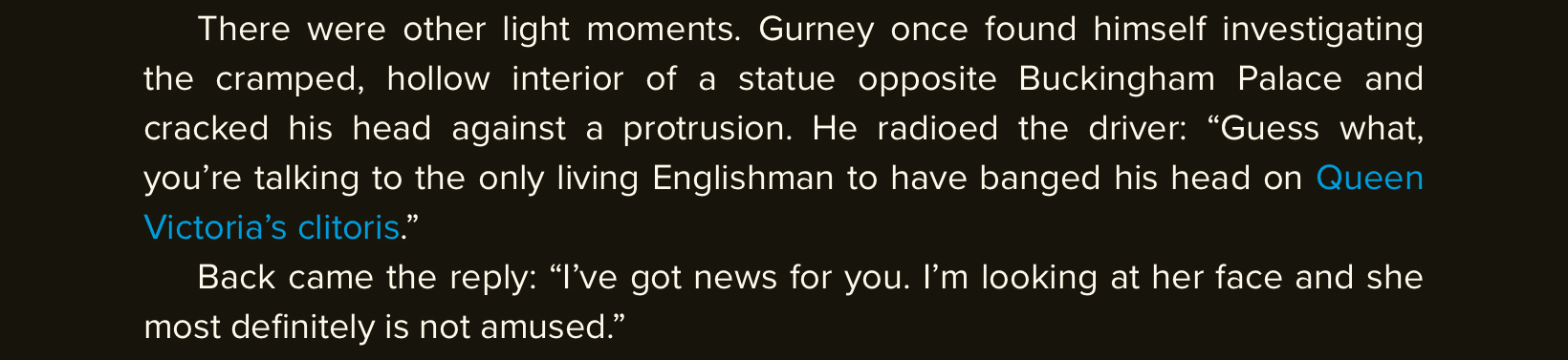



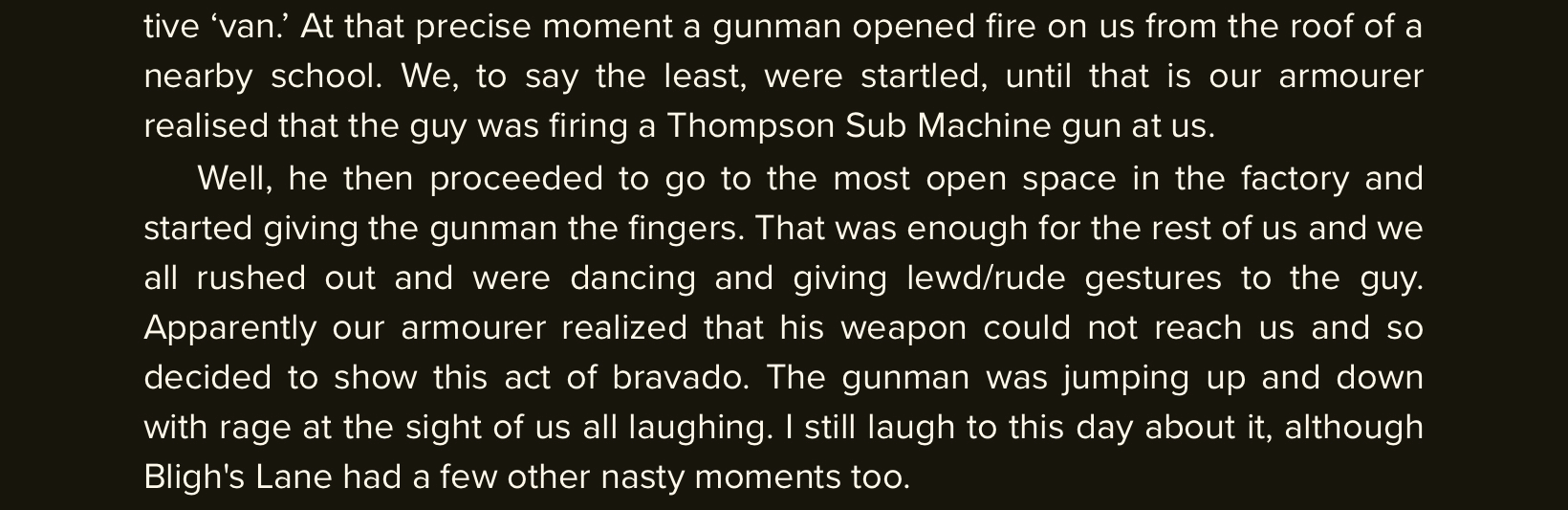
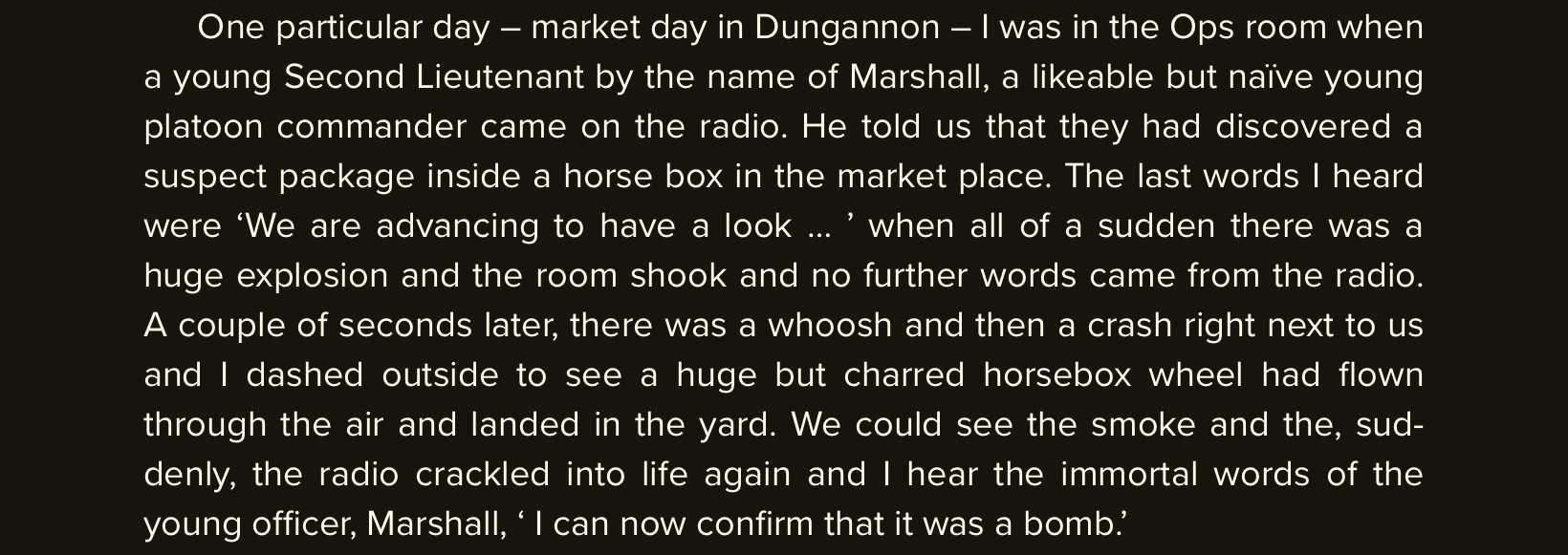
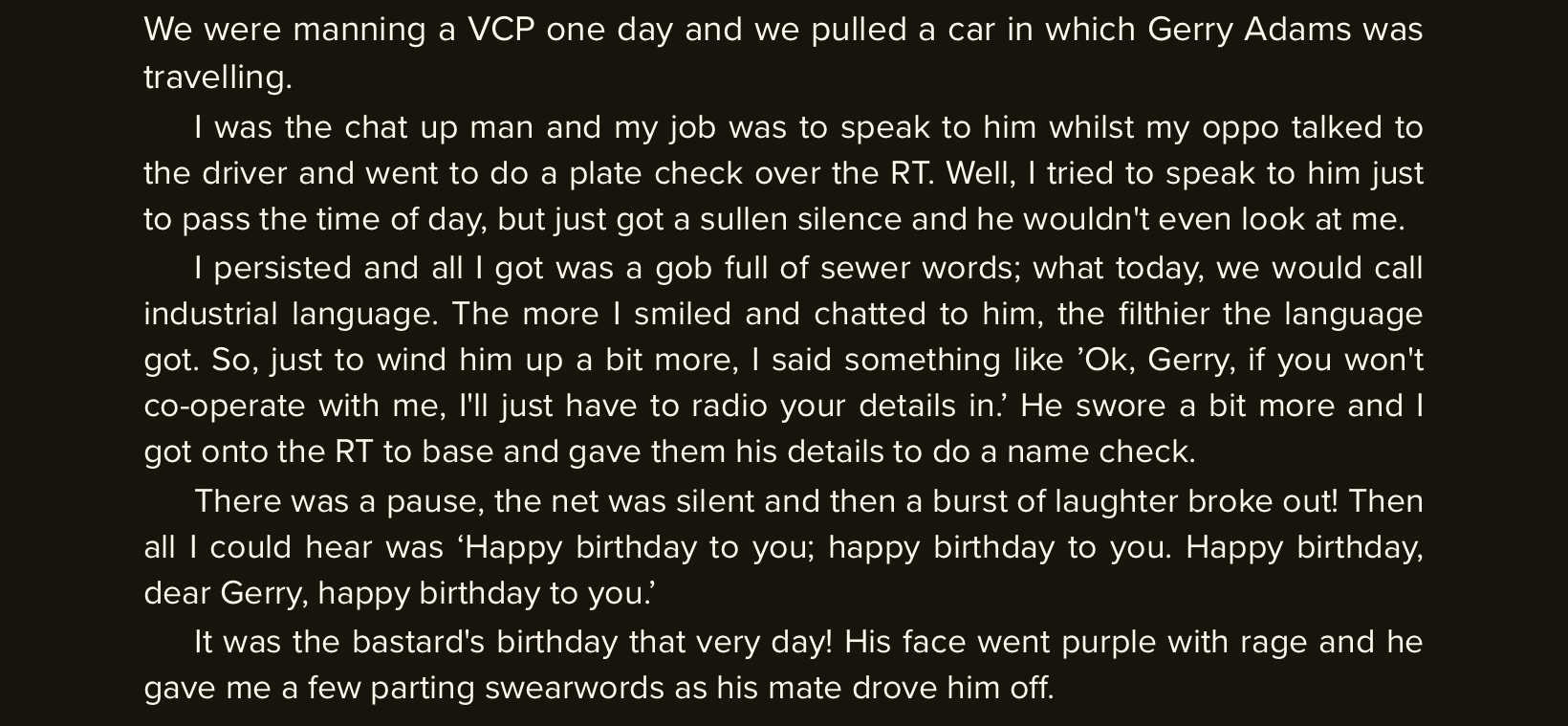

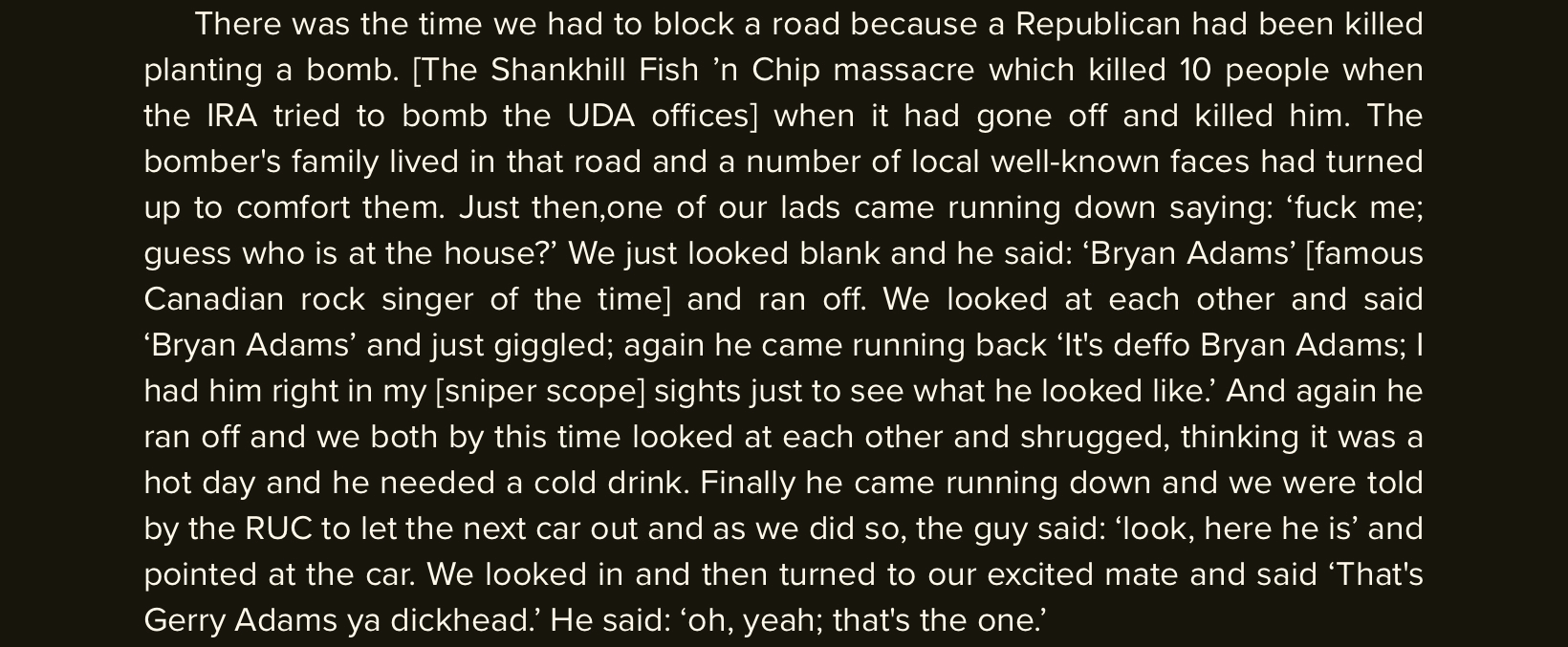
Quotes from "A Long War: Voices from the British Army in Northern Ireland 1969 - 1998" by Ken Wharton
- "Titanicus" by Dan Abnett .. Dan Abnett doing Dan Abnett things, it's good.
- "Interceptor City" by Dan Abnett .. Dan Abnett doing Dan Abnett things, it's good.
- "First and Only", "Ghostmaker", "The Guns of Tanith", "Straight Silver" by Dan Abnett; I think I re-read this series about once a year. It's the literary equivalent of comfort-food for me. And a regular reminder that I fucking hate Lijah Cuu. Although Flyn Meryn comes a close second.
- "Russia Under Putin - Fragile State and Revisionist Power" (edited) by Andrew S. Natsios is a collection of essays by that examines the paradox of Vladimir Putin's Russia - a declining, internally fragile state that nonetheless pursues aggressive, revisionist foreign policies.
The book argues that despite economic stagnation, demographic decline, and systemic corruption, Russia remains a well-armed, nuclear-capable power determined to undermine the international order. Good analysis, depressing conclusion. - "Red Hat Certified Engineer (RHCE) Ansible Automation Study Guide" by Alex Soto Bueno, Andrew Block; TL;DR I know Ansible pretty well already.
- "Gulag: A History" by Anne Applebaum has been on my mind and my (literal) shelf for years now. But for reasons I don't understand I was never able to read it. I enjoyed "Red Famine - Stalin's War on Ukraine", and Gulag is equally good. But try as I might, I always gave up after fifty pages or so. Not because I was put off by anything, my brain simply decided that it's not going to happen.
So when I was out of podcasts while cleaning one day, I decided to give the book a go as an audiobook, and that worked. I have finally "read" this book and can remove it from my pile of shame.
There's a lot of material out there on the Internet, and there countless papers, posts, and documentaries that have been made about it. However, most of them tend to focus on the horrors of the system (and horrible it undoubtedly was) rather than the system itself; its history, its developments, its people.
This book does exactly that. It's split in three parts, beginning with covering the origins of the Gulag, followed by a part describing what life and work in the camps actually was, and concluding with an analysis of the rise and fall of the so-called "Camp-Industrial Complex" between 1940 and 1986. It's an in-depth, yet personal book. Well-written and engaging, I can recommend it. - "The Provos: IRA and Sinn Fein" by Peter Taylor is a history of the Provisional IRA and its political wing, Sinn Fein, from their origins in the late 1960s through the Troubles and into the peace process. The book combines interviews, archival research, and the author's own eyewitness reporting. Fair, balanced, well-written.
- "The Red Brigades: The Terrorists Who Bought Italy to Its Knees" by John Foot; this book details the history of Italy's most infamous left-wing terrorist group. It traces the Red Brigades' origins in the radical student and worker movements of the 1960s, their escalation into a campaign of kidnappings, assassinations, and kneecappings, and their eventual decline. And boy, are they (or were, rather) a weird bunch.
- "Operation Wrath of God: The Secret History of European Intelligence and Mossad's Assassination Campaign" by Aviva Guttmann was a book I had been looking forward to for a long time, and I immediately ordered and read it once it was released.
It details and analyzes the covert collaboration between European intelligence agencies and Israel’s Mossad following the 1972 Munich Olympics massacre, doing so by drawing on unprecedented access to the Club de Berne archives.
The book reveals how European agencies provided critical intelligence and tacit support for Mossad's, even after the desaster of Lillehammer. It also looks at the moral and strategic dilemmas posed by state-sponsored assassinations. Highly recommended read. - "Homo Criminalis" by Mark Galeotti was not what I expected. I don't know what I expected, but it wasn't it. But that might well be because I've grown accustomed to a certain style of writing and choice of themes when it comes to this author.
The book is less a technical book on the subject of criminality and more of a philosophical tract, an assembly of semi-analytical musings of the history of criminality in connection to the history of mankind. As I said, not what I expected, but still a book I am happy to have read. - "When Nobody's Listening: Inside Sweden's Drug Gangs" by Diamant Salihu is what I wished "Dark Wire" by Joseph Cox would have been. Because it explained not just how the criminals used encrypted messengers and how the police "cracked" them (depending on the service we are talking about), but it also explains how those messengers became a thing, what impact they were having on the criminal underground, and what impact law enforcement actions had - and what the future is going to bring.
- "The Horror of Himmler's Death Squads" by Norman Ridley looks at the Einsatzgruppen's mass murders in Lithuania, Latvia, and Estonia during World War II - a tragic chapter that's woefully under-researched, or at least under-written-about.
Ridley details how these mobile killing units systematically executed Jews and other civilians, often with the complicity of local collaborators. The book highlights the brutal efficiency of these early Holocaust operations, which paved the way for the industrialized genocide of the death camps. And it also talks about the legacy the complicity of some parts of the local population affects history until this day.
July
- "Austria - A Soldier's Guide" isn't actually a book, but since I read it in book form I count it here. Book numbers go brrrrr!
- "Sayeret Matkal: The Greatest Operations of Israel's Elite Commandos" by Avner Shur, Aviram Halevi was not what I expected. With a lot of books written by or with the cooperation of former special forces members it quickly turns into a laudatio about heroism and the like. Not with this book. Of course, there's a level of pride involved.
But the authors don't shy back to point out what went wrong when, where, and how. And what the unit learned from that. It's definitely one of the better informal histories of a military unit that has been released in recent years. - "The Spymaster of Baghdad: A True Story of Bravery, Family, and Patriotism in the Battle against ISIS" by Margaret Coker was a deeply uncomfortable book. It was also an excellent, thrilling, engaging read. But first and foremost it was an uncomfortable book, on many levels.
- "Tribe: On Homecoming and Belonging" by Sebastian Junger was a hard-hitting read. It's not a professional psychological analysis of PTSD, but it's better than any scientific analysis of PTSD out there.
I talked to people about it, and the common response was that it's a book that gives people who rarely feel like they are being heard the rare feeling of being heard and seen. It also provided some much-needed explanation about things, things where I wasn't even aware of that they needed explaining. - "Verfassungsschutz" by Ronen Steinke taught me a lot of things about the German Verfassungsschutz that I wasn't aware of and wish I wouldn't be aware of. I'm absolutely not on the same page of the book when it comes to the solution for the multitude of problems with the Verfassungsschutz, I think disbanding it would be a bad idea - especially at this point in time, without and adequate service / organisation to replace it. But there are a lot of issues that definitely need addressing.
- "Death in the Fields: The IRA and East Tyrone" by Jonathan Trigg is very similar to "Death in Derry", except it's about East Tyrone rather than Derry. Good read.
- "In the Shadows: True Stories of High-Stakes Negotiations to Free Americans Captured Abroad" by Mickey Bergman provided an engaging account of unofficial diplomacy with the goal of getting citizens of the United States back home, from whatever hellhole prison they are currently rotting in for whatever reason. Surprisingly frank, yet still delicate and written with respect towards the people involved.
- "War" by Sebastian Junger is very raw account of combat and camaraderie, based on the author's 15 months embedded with a U.S. Army platoon in Afghanistan’s Korengal Valley. Junger explores the fear, adrenaline, and deep bonds that define the soldier's experience, as well as the moral and emotional toll of modern warfare .. and it uncomfortably resonated with me.
- "A State in Denial: British Collaboration with Loyalist Paramilitaries" by Margaret Urwin; this book takes a - rather damning, I must say - look at the British government's secret collusion with Loyalist paramilitary groups like the UDA and UVF during the Northern Ireland Troubles. Through the analysis of previously classified documents, the author reveals a pattern of official denial and high-level complicity in sectarian violence, including the state's refusal to proscribe the UDA for decades .. which I will strategically use to bully a British friend. Suck it, James.
- "Modern Warfare: Lessons from Ukraine" by Lawrence Freedman is a professional analysis of the first year of the full-scale Russian invasion of Ukraine, offering a comparison of the two sides' strategies. The author explains why Ukraine's classical battlefield approach has proven more effective than Russia's total war tactics, which combine military force with attacks on Ukraine’s socio-economic infrastructure - and attempts to guess what the future of the war will look like.
- "Inside the UDA - Volunteers and Violence" by Colin Crawford; This book is an insider account of the Ulster Defence Association (UDA) and its paramilitary campaign during the Northern Ireland Troubles.
Drawing on extensive interviews with UDA members (many conducted inside the Maze prison) the author provides a, as far as I know unique, look into the group's ideology, tactics, and internal tensions, including its shift from targeted assassinations to random violence and its struggles in the post-Good Friday Agreement era. - "OCT 7: The War Against Hamas Through the Eyes of an Israeli Commando Officer" by Elkana Cohen felt like propaganda. There's nothing that specifically screams propaganda, but something about it just feels .. off.
I understand that it is the product of journals the author was keeping during his time of military service in the Gaza Strip as part of the Israeli response to the events of October 7th, but still. The book felt sterile. Calculated.
If you're interested in the day-to-day experience of a grunt, it's worth your while. If you're looking for something objective or even "professional", this isn't the right book. - "Loyalists" by Peter Taylor surprised me, because I somewhat expected it to be a book that was attempting to "whitewash" the crimes perpetrated by Loyalists during The Troubles - but it wasn't.
The book is based on a series of (sometimes rather frank) interviews between the author and paramilitary leaders as well as gunmen, and loyalist / unionist politicians. The more I progressed in my reading, the more I realized that as much as I had thought that I had a nuanced view of The Troubles, I was still missing the perspectives of one side almost entirely.
I had mostly read works about the IRA, sometimes even written by former members of the various Republican organisations themselves, and the various aspects of the conflict in general. But voices from the loyalist / unionist community are something that I was missing. Something I need and want to change, an endeavor for which this book provides an excellent starting point. - "Killing Thatcher: The IRA, the Manhunt, and the Long War on the Crown" by Rory Carroll; I enjoyed this one tremendously. It's engaging and written well. The author manages to strike a balance between making the book an entertaining read and sticking to the facts.
Similarly to what Patrick Radden Keefe does in "Say Nothing" (which I can also recommend wholeheartedly), Carroll makes the attack against Margaret Thatcher the center of the book, but not the focus. Which works out extremely well. - "Double Eagle" by Dan Abnett is a typical "Dan Abnett". In my personal opinion he's one of the best, if not the best, writers to ever bless Black Library. This is no exception.
- "The Trigger Men" by Martin Dillon was an interesting, but in all honesty the book was mostly carried by the fact that I like the author. There where way too many speculations in it for my taste.
June
- "Black Saturday" by Trey Yingst is a firsthand account of the events of October 7th 2023, from a journalist who's been covering Israel for years. Refreshingly unbiased while intensely personal.
- "One day, when it's safe, when there's no personal downside to calling a thing what it is, when it's too late to hold anyone accountable, everyone will have always been against this" by Omar El Akkad; .. "West bad, Israel bad, Palestinians innocent" interspersed with a lot of "mimimi".
- "Who Will Defend Europe? An Awakened Russia and a Sleeping Continent" by Keir Giles looks at Europe’s security vulnerabilities in the face of a resurgent and aggressive Russia. The author is a known scholar of Russia, and argues that Europe has become dangerously complacent, relying too heavily on the U.S. for defense while failing to address the growing threat from Putin's regime.
- "Death in Derry: Martin McGuiness and the Derry IRA's War Against the British" by Jonathan Trigg focuses on the Provisional IRA's campaign in Derry during the Troubles, concentrating on the rise of Martin McGuinness from a young butcher's assistant to a key IRA leader.
A lot of interviews with and statements from people who were directly involved in the historic events discussed in the books provides a very personal history of this part of the Troubles. - "Every Body Counts" by Barbie Latza Nadeau; This book is a moving, obviously deeply researched exposé of the global human trafficking industry. It looks at how desperate migration and organized crime intersect to exploit millions of lives.
Nadeau, who is an investigative journalist, uncovers the economics behind sex trafficking, organ trading, forced labor, and drug mules, that way showing how every body becomes a commodity in a shadow economy worth billions. - "Der Adler und die drei Punkte" by Roland Girtler is a book that's going to be confusing as hell if you are not familiar with Vienna and its history. If you are, then it provides fascinating insight in the criminal underworld of Vienna after World War II.
- "Unredacted - Russia, Trump, and the Fight for Democracy" by Christopher Steele looks at threats posed by Russian interference and Donald Trump's political rise, as seen through the eyes of the guy behind the infamous "Steele Dossier". Much less conspiracy-y than I expected it to be. Still, despite it being an engaging read, take it with a grain of salt. Or two.
- "Ciaphas Cain: Defender of the Imperium" by Sandy Mitchell; I have grown to like Ciaphas Cain, despite not enjoying his stories when I first encountered them as a kid. But now, as a working adult, I can completely understand his approach to his job, trying to avoid responsibility and dangers. Only to eventually end up in hairy situations despite his efforts. A genuinely funny way of telling stories in the Grimdark setting of the far future.
- "Guerilla Warfare" by Ernesto Che Guevara; this book draws from his firsthand experience in the Cuban Revolution. Published in 1960, the book outlines his "foco" theory, arguing that a small, determined guerrilla force can spark broader revolution by creating liberated zones and mobilizing popular support, especially in rural areas.
Guevara emphasizes the importance of popular backing, mobility, and ideological commitment, and contrary to Mao, this work has indeed become a kind of a blueprint for some insurgent movements globally. - "On Guerilla Warfare" by Mao Tse-Tung; A lot of people call it "a foundational text on irregular warfare", and I mean .. yeah, "foundational" as in "the absolute, obvious basics".
- "In the Shadows" by Mickey Bergman gives a personal account of the world of international hostage rescue. The author talks about, among other things, missions to free Americans like Brittney Griner, Otto Warmbier, and Trevor Reed from foreign prisons. A bit to self-promotional for my taste.
- "The Language of War" by Oleksandr Mykhed is a deeply personal account of how Russia's full-scale invasion of Ukraine shattered everyday life and transformed language itself into a battleground.
The author, a writer turned soldier, blends vivid day-by-day chronicles of the war with voices of family, friends, and witnesses to atrocities, creating a moving record of both the physical and psychological toll of war.
May
- "Knife. Meditations After an Attempted Murder" by Salman Rushdie; I rarely read prose, but made an exception for this because I was surprised that after all of these years (the Fatwa against him was issued more than 35 years ago!) someone made an attempt on his life. And I was curious to learn what Rushdie had to say about that.
All I can say that the book is personal and beautiful. And I do not regret reading it the tiniest bit. - "Reading the Waves" by Lidia Yuknavitch .. I should really write my "reviews" directly after I read the books. Because I barely remember what this one was about. But I remember it to be a pleasant read, so .. yeah. There's that, I guess.
- "Die Sex-Besessenheit der AfD" by Daniela Rüther was great for two reasons. One because it's the first proper analysis of how the far-right AfD party weaponizes issues of gender, sexuality, and family policy to advance its nationalist and völkisch agenda. Second because the constant creative roasts of the completely irrational fascination by AfD with what other people do when they are naked were 10/10 funny.
- "One Day in September" by Simon Reeve is a new account of the 1972 Munich Olympics massacre, where Palestinian terrorists from the Black September group took Israeli athletes hostage. The book, relying on newly released documents, is informative, thorough, and neutral.
- "Nord Stream - Wie Deutschland Putins Krieg bezahlt" by Steffen Dobert, Ulrich Thiele pissed me off quite a lot. Not because the authors did anything wrong or the book was bad, but because it's always uncomfortable to be confronted with a mix of personal greed, blatant corruption and local incompetence / negligence. Especially when it benefits the Russian state. Good read, but prepare to be angry.
- "Shitbürgertum" by Ulf Poschardt aka "liberalism has been destroying itself, abandon current liberalism and follow my - obviously better version of liberalism" .. pseudo-intellectual circlejerking. The only reason I managed to complete it was because it's short. Not going to lie, kind of annoyed about the fact that I bought a physical copy of this.
- "First Class Comrades: The Stasi in the Cold War, 1945 - 1961" by J. Boulter shone a light on lesser known aspects and periods of the Stasi, looking at parts / activities of the organisation that I wasn't aware of before - or at least not in great detail.
The book looks at how the Stasi shaped the creation of the GDR, how its operational methods and tactics evolved over time and how it began to interact with other states in the sphere of the influence of the Soviet Union. It's not a light read, and at nearly 800 pages not a short one, but one I can recommend. - "Die Rückseite des Lebens" by Yasmina Reza was recommended to me by a friend. I read it in one sitting, and after I laid the book down I just stared at nothing in particular while being busy trying to figure out what this book was actually even about.
- "On Privacy" by Lawrence Capello is something I'd happily gift to the intellectually inclined person in my social circle, because it - in a rather academic fashion - explains why privacy matters in the digital age and how to protect it. Not particularly useful for me, but still, okay-ish read.
- "Road to October 7: A Brief History of Palestinian Islamism" by Erik Skare analyzes how Palestinian Islamism evolved into a central force in the resistance against Israel.
Skare argues that the movement is far more complex and dynamic than commonly portrayed, shaped by internal debates between moderates and hardliners, as well as external pressures like Israeli repression and regional power shifts. Really fascinating insight.
April
- "Discipline is Destiny" by Ryan Holiday; The book tries to explore how self-discipline, rooted in Stoic philosophy, shapes success and personal freedom. I say "tries to" because the book quickly spirals into borderline toxic masculinity influencer bullshit. Meh.
- "Geopolitical Cyber Threat Intelligence" by Robin Dimyanoglu
- "The State Within a State: The KGB and its Hold on Russia - Past, Present, and Future" by Yevgenia Albats looks at how the power and influence of the KGB (and its successors) in Russian politics and society remain unbroken after the fall of the Soviet Union. Drawing on interviews with former agents and KGB archives, the book explores the organization's role in suppressing dissent, manipulating reforms like perestroika, and embedding itself as a shadowy “state within a state.”
- "Anatomy of Terror: From the Death of Bin Laden to the Rise of the Islamic State" by Ali Soufian; This book traces the evolution of jihadi terrorism from al-Qaeda to the Islamic State. Soufan dissects the ideology, leadership, and strategies of these groups, revealing their strengths, weaknesses, and the geopolitical forces that shaped their rise. I don't know how the author did it, but I nearly read it in a single sitting. The writing style tremendously encouraged a flow-like reading state.
- "The Russian Way of Deterrence: Strategic Culture, Coercion, and War" by Dmitry Adamsky; I'm not going to lie, this book was dense and challenging to read. But it's a read I would nonetheless strongly recommend to anyone seeking to understand Russia's military and political behaviour.
The book is an in-depth analysis of how Russia’s unique strategic culture shapes its approach to deterrence and coercion. The author argues that Russia's strategy (what he calls "deterrence à la Russe") differs fundamentally from Western models, integrating nuclear, conventional, and informational tools in ways that reflect deep historical and cultural influences. - "Underground Economy - Wie Cyberkriminelle Wirtschaft und Staaten bedrohen" by Otto Hostettler, Abdelkader Cornelius is a book that I'm not going to honor with a lot of words. To put it short and concise: Don't waste your time and money on this. It's bad, horribly so. I wish more people who write about infosec would actually know what they are talking about. Because these two authors definitely do not.
- "Death Is Our Business: Russian Mercenaries and the New Era of Private Warfare" by John Lechner is a deeply researched exposé of the Wagner Group and the resurgence of private military companies as tools of Russian statecraft. To book explores how Yevgeniy Prigozhin's mercenary (and others like it) army became a pillar of Russia's global strategy, exploiting conflicts in Africa, the Middle East, and Ukraine to secure resources, undermine Western interests, and project Kremlin power.
- "First Person: An Astonishingly Frank Self-Portrait by Russia's President" by Vladimir Putin is a book-length interview given by him, published in 2000, just as he was rising to power.
The book is an extremely curated glimpse into Putin's early life, his KGB career, and his political philosophy, tailored in a way to make him appeal to a Western audience as he wanted to be seen at the time. I'd say the book is valuable as a historical document, providing insight into how Putin wanted to be perceived at the start of his presidency, which is precisely why I read it. But please, don't take any of it seriously. - "The Long Hangover" by Shaun Walker is a "bottom-up" exploration of how Vladimir Putin has tried to reshape Russia's national identity by exploiting the memory of Soviet victory in World War II.
The author a longtime Moscow correspondent for "The Guardian", argues that Putin's regime has tried to fill the void left by the Soviet collapse by reviving a sense of national pride and purpose, often at the expense of historical truth and regional stability .. which, given the developments in Eastern Europe in the last couple of years, it's a painfully accurate assessment. - "Loveology" by Stefan Gates tries its hand at an evidence-based exploration of the science behind love, sex, and relationships. Combining research from psychologists, biochemists, and neuroscientists, the author seems to manage to do that. I say "seems" because all of these things are different for everyone, and I'm not a scientist. But 't was a fun read.
- "Space Wolf", "Ragnar's Claw", "Grey Hunter", "Wolf Guard", "Son of Fenris", "Wolf's Honour" by William King; roughly twenty years after I read "Space Wolf" for the first time I finally managed to read all books of the series. As is common with Black Library it's not high culture, but an entertaining read nonetheless. Not quite on the level of a Dan Abnett for me, but still very much worth my time.
March
- "Die Hisbollah: Irans Schattenarmee vor den Toren Israels" by Joseph Croitoru; This is, as far as I know, the first comprehensive German-language account of how Iran has transformed Hezbollah into a serious political, social, and military force in Lebanon since the 1980s.
The author analytically explains its deep roots in Lebanese society and its ongoing threat to Israel and regional stability. Definitely one of the best German-language books I have read about the Middle East so far. - "The Main Enemy: The Inside Story of the CIA's Final Showdown with the KGB" by Milt Bearden is a personal account of the spy wars between the CIA and KGB during the final years of the Cold War. It's written well, but .. it feels at times too much like a spy thriller rather than a serious history (or at least historic) book.
- "Black Hat Bash" by Dolev Farhi and Nick Aleks; I read this because I was preparing an introduction to GNU/Linux for my juniors and wanted to be able to recommend them some books to get going if they want to learn more, and this one was the only one on my list of potential recommendations that I had not read until then.
The book tries to be an introduction to bash (scripting) while simultaneously not boring you to death and imploring you to study the (now defunct) Bash Hackers Wiki. In this it succeeds, and I would happily endorse this book both for people who are new to offensive security and to people who might have some experience with offensive security on Windows and want to expand their knowledge to include Linux. - "Spy's Journey: A CIA Memoir" by Floyd Paseman puts me into a bit of a pickle. Because I forgot to write down some notes about the book when I actually read it, I don't really remember it all that clearly several months on. Which probably means that it was neither outstandingly good nor particularly bad.
- "Intrusion Detection Honeypots: Detection through Deception" by Chris Sanders; I think the book is good. I'm wording it that way because I didn't really like or enjoy it. But that's probably on me. If you haven't been exposed to honeypots before, then there's a lot to learn. I was also surprised that kippo is still around. Because that thing was already rather dated when I first encountered it in 2015.
- "Allahs mächtige Influencer: Wie TikTok-Islamisten unsere Jugend radikalisieren" by Stefan Kaltenbrunner, Clemens Neuhold - I don't know what I expected, but the expectations I didn't know I had where met when the authors started arguing for chat control as appropriate defence against terrorism and radicalization of youths, thus proving a fundamental lack of understanding of both the subject matter and of technology. Save yourself the read.
- "Treue: Liebe, Begehren und Verrat – die Frauen in der Mafia" by Roberto Saviano explores the often overlooked role of women in Italian organized crime. It looks at how mafia structures and values dictate not only criminal enterprises but also the intimate lives, marriages, and betrayals of the women involved. It's a depressing read, a glimpse into a world where brutal, patriarchal codes and rites still dominate.
- "The Electricity of Every Living Thing: One Woman's Walk with Asperger" by Katherine May is a deeply personal and life-affirming memoir that chronicles May’s journey of self-discovery after receiving an autism diagnosis in her late thirties.
The book intertwines her 630-mile walk along the South West Coast Path with reflections on her life, motherhood, and the challenges of navigating a neurotypical world as an autistic person. As someone similarly affected, it was a very moving read. - "Pilnacek - Der Tod des Sektionsführers" by Peter Pilz; This is a somewhat controversial investigative book that questions the official narrative surrounding the death of Austrian justice official Christian Pilnacek.
The author, a former politician and investigative journalist, presents his year-long research effort that highlights inconsistencies and alleged cover-ups in the case. He does not cross the line and stops short of arguing that Pilnacek was actually murdered, but he somewhat implies it in the concluding chapters.
I was hesitant to buy this, because the author himself is a controversial person in Austria. But, surprisingly, the book didn't veneer into conspiracy theories, instead sticking to pointing out the significant amount of inconsistencies in the official investigation. - "The Deception Game" by Ladislav Bitmann made it to the top of my reading list after I finally found a copy that was under 200$ on eBay. No, I'm not going to ever disclose how much I actually paid for it. Let's just say it was the most expensive book I ever bought. 🥲
The book is a firsthand account of Czechoslovak intelligence operations during the early-ish stages of the Cold War, written by a former officer who (later on) defected to the West. It's a fascinating inside look at how Soviet-bloc intelligence agencies worked at the time, how they conducted political warfare and disinformation campaigns, particularly targeting the United States and Western Europes. - "With the Old Breed: At Peleliu and Okinawa" by E.B. Sledge; after watching "The Pacific" once again I decided to give this a read after all. Expectedly depressing, but good nonetheless.
February
- "Wintering: The Power of Rest and Retreat in Difficult Times" by Katherine May; I don't remember why I ended up with this book in the first place, only that I decided to finally read it in order to get it out of my "pile of opportunities".
It ended up being a very personal account of dealing with hardship and a soft extrapolation of potential lessons others could learn in order to give themselves the rest and space they need for making it through tough times in their lives. I read it almost in a single sitting because the writing style drew me in .. which probably means that I would recommend it to people interested in these kind of books. - "Putin's Wars: The Rise of Russias New Imperialism" by Marcel H. Van Herpen systematically analyzes several significant military conflicts during the (ongoing) reign of Vladimir Putin, namely the Second Chechen War, the 2008 War with Georgia, and the (ongoing) war with and in Ukraine.
The author argues that these wars were not merely defensive reactions but offensive moves driven by Putin's ambition to rebuild a Russian empire, reversing the post-Soviet decline and consolidating his authoritarian rule at home.
While that's an argument that (in my opinion rightfully so) is made regularly, few experts or authors take the time to explain their reasoning by putting these conflicts in historical context in order to show how the Russian regime uses military action to legitimize its power. Oh, and it's well-written too! - "Die Kunst des Cyberkrieges" by Peter Kestner caused me profound feelings of "ok, boomer". Even though I have no idea how old the author is.
I know that Sun Tzu is very popular within the "business crowd", and it's not really appropriate there most of the time. Especially because a lot of cherry picking is going on. Putting "The Art of War" onto information security doesn't really work either. Save yourself the time, effort, and potentially money. - "Intelligence-Driven Incident Response" by Rebekah Brown and Scott J. Roberts is one of those books that I should have read years ago, but somehow never managed until now.
The authors not just argue that threat intelligence significantly enhances the effectivity of an already existing incident response plean, it also provides ample information and resources on how to actually achieve that.
I wish more people in the industry would read this book because, at least that's my experience, an actual understanding of the "intelligence" part within "threat intelligence" is something a lot of analysts seem to lack. Which, in turn, hampers their work greatly. - "The Secret History of Soviet Russia's Police State" by Martyn Whittock; most books about secret services in the Soviet Union / Russia talk about the more visible forms of violence and state repression. This book instead focuses on the complex reality of the Soviet police system.
Whittock argues that, even though repression and state violence were central to the regime's power, loyalty (in the widest sense of the word) was also ensure through appeals to ideology, social benefits, and a sense of shared purpose. I found that a welcome different approach / point of view. - "Russian Politics: A Very Short Introduction" by Brian D. Taylor does what it says it would. It provides a short, well-rounded introduction into modern Russian politics, including historic context and potential future developments.
- "Spetsnaz - The Inside Story of the Soviet Special Forces" by Viktor Suvorov felt like the dirty little brother of the book by Tor Bukkvoll - it is less of a historic textbook and more of a memoir of an insider trying to transform his memories into a textbook. It deals a lot more with the operational level of Spetsnaz as well as including borderline philosophical musings about what Spetsnaz actually is, or should be in the eyes of the people who created it.
A lot of the things the author states are without sourcing, but the book is nonetheless an interesting read and provides a personal context to the more "dry" historic facts. - "Moskaus Schattenkrieg" by Jessikka Aro; while a lot of books on the issue of Russian below-threshold activities focus on methods and on specific operations, Jessikka Aro instead concentrates on the impact Russian activities have on both Europe as a whole as well as on a personal level.
She does this by, among other things, writing about her own harrowing experiences as a target of Russian troll campaigns, she argues that events like the Smolensk air disaster are part of a broader pattern of state-sponsored terror and propaganda. - "Intelligence and Contemporary Conflict - Communication in Diplomacy, Statecraft and War" (edited) by Matthew Hefler; this collection of essays explores the critical role of secret intelligence and covert operations in shaping modern diplomacy, statecraft, and warfare.
The book underscores how clandestine activities (such as subversion, disinformation, and covert political actions) are increasingly pivotal in navigating the complexities of international conflicts. Enjoyable read.
January
- "Spetsnaz - A History of the Soviet and Russian Special Forces" by Tor Bukkvoll is the first comprehensive history of the Soviet and Russian special forces that I have encountered so far. He talks about their evolution from their establishment in the early 1950s to the (reasonably) present day.
The most interesting part to me was that the author doesn't just talk about their history in the sense of their missions and conflicts they were involved with, but also dives into the process of building and organizing them within existing state structures - and the resistance that process encountered at times. - "Run Your Own Mailserver" by Michael W. Lucas; "Absolute OpenBSD" was one of the first technical books I ever read from cover to cover. Not just because I found OpenBSD interesting, but because Michael W. Lucas is one of the few technical authors I know who manages to mix enjoyable writing and technical knowledge.
I was susprised that Lucas used Postfix as MTA for his book, given that OpenBSD comes with OpenSMTPd. But it's what he's comfortable with, so that choice makes sense. I'm not going to rebuild my own mailserver based on this book (something, something, never touch a running system), but if I were to set up a mailserver for the first time, I would go for the stack described in this book and would use the book to get things up and running. - "Tracers in the Dark" by Andy Greenberg; I happened to read this right around the time when Ross Ulbricht was pardoned and released from prison. Amusing coincidence.
I enjoyed the book. There aren't particularly many new things in it for people who have been following the case of Silk Road even remotely, but it's nonetheless a well-written summary of criminal investigation into Bitcoin-related crime that puts you into a reading flow quite easily. - "Kinder der Gewalt - Ein Porträt Russlands in fünf Verbrechen" by Julian Hans uses five case studies to take a look at problems that are endemic within Russian society, mostly ones of the violent kind.
He, among other authors that have spoken and written about this in the past couple of years, argues that Vladimir Putin plays a significant role in Russia, but him leaving office wouldn't magically make things go away and turn Russia into a liberal democracy over night.
Hans suggests that violence is deeply ingrained in Russian society on all levels, which has led to at least one generation of people who never had the experience that their lives and their safety is protected (e.g. by law enforcement) and respected. Which, in turn, makes it hard for them to develop empathy and compassion for others - leading to a perpetuating cycle of violence that perpetrates everything.
The book is a depressing read, both because the individual stories are sometimes heartbreaking, and because despite the author assuring that not everything has yet been lost, it looks unlikely that things will get better soon. - "The Less You Know, The Better You Sleep" by David Satter; I avoided this book for quite a while because one of the focal points of the author was the apartment bombings of 1999. This series of events is surrounded by uncertainty about the perpetrators, a question that is unlikely to ever be conclusively resolved.
That uncertainty tends to breed speculation, which is fine, and conspiracy theories - which is generally fine by me as well, but because I've read my fair share of them I wasn't exactly keen on reading more of them.
As it turned out however, I was mistaken. The book indeed tells the story of the apartment bombings, and David Satter is clear about who he thinks was behind the attacks. But he doesn't dwell on this, he does not set out to present the reader with tons of (real or perceived) evidence.
He merely uses the apartment bombings as the starting point for examining how the presidency of Boris Yeltsin was the beginning of the criminalization of Russia, what the rise of Vladimir Putin brought with it, and how Russia got to the point where it is now.
If you want to read something about the apartment bombings of 1999, skip Felshtinsky and read this instead. - "Have Personality Disorder, Will Rule Russia" by Jennifer Eremeeva was genuinely funny. A short, humorous summary of Russian history with regular roasts of whoever was in power at the time period covered at that particular page.
- "Grunt: The Curious Science of Humans at War" by Mary Roach is one of the best books I've read in a while. Not only did I learn a lot about the aspects of warfare that aren't really talked about much (for example penis transplantations or uniform design), I did so while constantly being privy to what the author thought and experiencing her discomfort as she tries to navigate a military environment as a complete civilian.
- "The Hacker and the State: Cyber Attacks and the New Normal of Geopolitics" by Ben Buchanan was disappointing, sadly. While I expected an analysis of the changing landscape of modern inter- and intra-state conflict, instead I got a lengthy, repetitive explanation that the United States has an intelligence community, that the United States spy and that the Chinese spy as well. Think "Guardian" reporting on the Snowden leaks stretched to ripping point to be book length.
- "Counter-Intelligence: What the Secret World Can Teach Us About Problem-solving and Creativity" by Robert Hannigan taught me a lot of things. I learned more than I could have thought about the history of the modern British intelligence services and other historic events or developments. Which was interesting. But even after having finished the book I have no idea why it is titled the way it is ..